
What is a Chiller central air conditioning system?
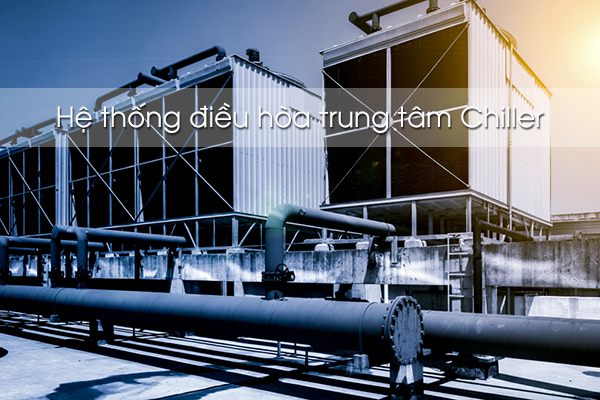
A Chiller central air conditioning system consists of one or more central chiller units combined into a single integrated system that efficiently cools every area of large factories, buildings, hotels and villas. The system uses water as the cooling medium, circulating it through a network of pipes to heat exchange coils that cool the air.
Components of a Chiller central air conditioning system

Schematic diagram of a water-based Chiller system
- Central chiller unit: Produces chilled water and delivers it through a piping network to the heat exchange coils (installed in the conditioned spaces) to cool the air.
- Heat exchange coils: here, chilled water from the chiller passes through the indoor coil, exchanging heat with the room air to provide cooling.
- Cooling tower and water pumps: reject the heat from the condenser after the chiller has cooled the water in the evaporator.
- Chilled water piping and pumps: distribute chilled water from the central chiller to the FCU heat exchange coils.
- Cold air distribution ductwork: distributes cold air from the FCUs through the diffusers to the areas that need conditioning.
- Electrical control system: Controls and interlocks the equipment in the system (chillers, FCUs, water pumps and cooling towers)
Characteristics of a Chiller central air conditioning system
- The central chiller can be located on the roof or in a basement plant room. The heat exchange coils are installed in the conditioned rooms, while the chilled water pipes serving them run through service shafts and above false ceilings. As a result, installing the system does not affect the architectural structure of the building.
- Cooling is delivered through ductwork and ceiling diffusers to each area of the conditioned room, so diffusers can easily be arranged to ensure an even distribution of cool air throughout the space.
- With a central system, adding fresh air is very simple: AHU air mixing units are fitted to the ductwork to supply fresh air and blend it with the return air of each FCU and AHU.
- Because the system is water-cooled, the chiller runs stably and is barely affected by outdoor temperatures.
- Maximum energy savings thanks to a low power consumption ratio and excellent capacity control. During operation, the chiller automatically adjusts compressor capacity to keep electricity costs to a minimum, significantly reducing the operating costs of the whole system.
- Highly durable, with a service life of over 15 years
- A wide capacity range lets you choose units sized to suit each type of project, and the system is easy to expand later.

How many types of Chiller central air conditioning are there?
There are 2 types of Chiller central air conditioning:
- Air-cooled Chiller central air conditioning system: comprises the central unit, cold air distribution ducts, condenser cooling equipment, etc., and works by cooling with air and rejecting condenser heat with air. The central unit produces cold air and supplies it to the conditioned spaces through the ducts. There, the cold air acts as the heat exchange medium, absorbing heat from the room and lowering or raising its temperature and humidity. Once this process is complete, the air returns to the central unit through a separate return duct.

- Water-cooled Chiller central air conditioning system: comprises the central unit, heat exchange coils, condenser cooling equipment, water pumps, etc., and works by cooling with water and rejecting condenser heat with air. Chilled water produced by the central chillers is supplied to heat exchange coils located in the spaces to be conditioned. There, the water acts as the heat exchange medium, absorbing heat from the room and lowering or raising its temperature and humidity. Once this process is complete, the water returns to the central chiller and starts a new cycle. This water-cooled Chiller system suits the conditioning requirements of different spaces with different temperature and humidity settings. It does not demand much installation space: a gap of about 100 – 200 mm between the false ceiling and the slab is enough.

Advantages of a Chiller central air conditioning system
- The system runs very stably and is highly durable for long-term use.
- Because it uses water for cooling, there is no risk of poisoning or accidents caused by refrigerant leaks
- Suitable for buildings such as hotels, offices and factories of any height and architectural style, and ideal for large-scale projects
- Able to treat air to a high level of cleanliness, meeting every requirement for removing dust, contaminants, chemicals and odours
- Requires little maintenance and repair
Disadvantages of a Chiller central air conditioning system
- Takes up installation space because of bulky ductwork
- Labour-intensive to install
- High power consumption
- Requires highly skilled operating staff
- FCUs need regular periodic maintenance
- Electricity costs cannot be metered separately for individual areas.
If you need consultancy on the design and installation of a CHILLER CENTRAL AIR CONDITIONING SYSTEM, please contact TechConnect Vietnam for the best advice and support.
Techconnect Vietnam Engineering and Trading Co., Ltd
- Address: FLC Garden City Urban Area, Dai Mo Ward, Nam Tu Liem District, Hanoi
- Hotlines: 0988 883 961/ 0987 989 822
- Email: techconnect.mepf@gmail.com
- Website: https://techconnectmepf.com/en/