
What is a local (unitary) air conditioner? Is it the right choice for you? Let the experts at TechConnect Vietnam answer these questions in the article below!
What is a local air conditioner?
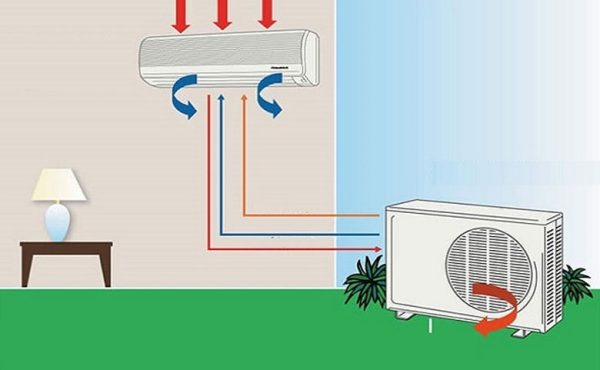
Like other types of air conditioning, a local air conditioner consists of two main parts: the outdoor unit and the indoor unit.
The compressor sits inside the outdoor unit and rejects heat to the outside environment. This is by far the most widely used type of air conditioner today.
As lifestyles evolve and customer expectations rise, local air conditioners keep improving: they now feature attractive designs, suit a wide range of spaces and are easier to install and maintain.
Types of local air conditioners
Local air conditioners currently fall into two main types: single-unit (window) air conditioners and two-unit (split) air conditioners.
Single-unit air conditioners
This type combines the outdoor unit and the indoor unit in a single casing. At a glance, it looks like an electric fan mounted in the wall. It is also known as a Window Type unit because it is installed like a window.
Capacity: single-unit air conditioners cover a wide capacity range, from 7000btu/h to 24000btu/h.
However, this type is rarely used nowadays

Two-unit (split) air conditioners
This is the more common type of local air conditioner, with separate outdoor and indoor units. The outdoor and indoor units are connected by refrigerant piping and electrical cables. The compressor sits inside the outdoor unit and rejects heat to the outside environment. Users can control the operating modes with a remote control or a wired controller (depending on the model).
Split air conditioners offer considerably higher capacities than single-unit models, ranging from 9000btu/h to 60.000btu/h. Specifically, you can choose from capacities such as 9.000 BTU, 12.000 BTU, 18.000 BTU, 24.000 BTU, 36.000 BTU, 48.000 BTU and 60.000 BTU. The number of models available varies from brand to brand.
Note: when installing this type of air conditioner, choose suitable locations for the indoor and outdoor units, as the length of the piping connecting them is limited

Pros and cons of local air conditioners: when should you use one?
Advantages of local air conditioners
- Quick and easy installation: local air conditioners have a fairly simple design, saving users time and installation costs. With some basic knowledge of air conditioning, you could even install one yourself without a technician.
- Independent operation: they are easy to clean and do not affect other systems such as multi-split or central air conditioning.
Disadvantages of local air conditioners
- With split air conditioners, placing outdoor units on the outside of modern buildings spoils the appearance of the whole building. In addition, the small balconies of apartments are not well suited to this type of air conditioner.
- Compared with multi-split or central air conditioning, local air conditioners offer weaker cooling performance. At peak times, such as on sweltering summer days, cooling may be uneven because the outdoor unit becomes overloaded and cannot reject heat quickly enough.
- High power consumption. In addition, local air conditioners have a shorter service life than other types (only 5-6 years).
When should you use a local air conditioner?
For these reasons, the air conditioning experts at TechConnect Vietnam recommend local air conditioners only for small spaces without demanding technical requirements, such as bedrooms, living rooms and small offices. For large spaces that need even cooling and have high technical requirements, such as shopping centres, supermarkets, villas and mansions, we recommend VRV central air conditioning or multi-split air conditioning to ensure sufficient capacity.
When choosing a local air conditioner for a room, you should also select a capacity that matches the room size. Avoid using an undersized unit in a large room, as this overloads the machine. It will not only waste electricity but also wear out faster. You should also take the room’s heat sources into account. If the room is used by many people or contains many heat-generating electronic devices, choose a slightly higher capacity for thorough cooling.

A trusted air conditioning supplier and installer
TechConnect Vietnam is a leading provider of air conditioning solutions for projects ranging from apartments, luxury condominiums, villas and private houses to commercial buildings, factories, office buildings and event centres. With a team of engineers trained to Japanese certification standards and many years of consulting and design experience, TechConnect Vietnam is proud to offer customers the best solutions for their homes.
TechConnect Vietnam currently offers COMPLETELY FREE on-site surveys, consultation and central air conditioning system design for homes, whether or not you make a purchase. So don’t hesitate to contact us now and let our experts help you choose the product that offers the best capacity, performance, durability and cost for your home.
TechConnect Vietnam Engineering and Trading Co., Ltd.
- Address: FLC Garden City Urban Area, Dai Mo Ward, Nam Tu Liem District, Hanoi
- Hotlines: 0988 883 961/ 0987 989 822
- Email: techconnect.mepf@gmail.com
- Website: https://techconnectmepf.com/en/