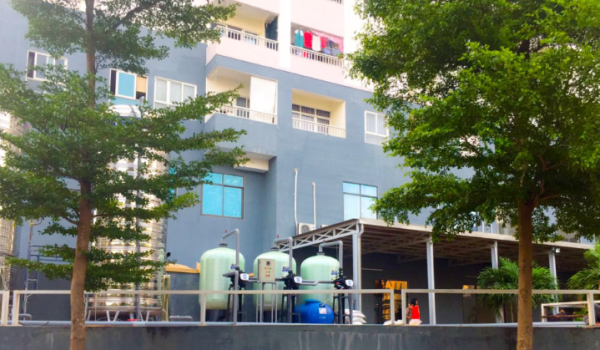


What is a lightning protection system?
A lightning protection system (LPS) provides a path through which a lightning strike can enter or leave the earth without passing through, and damaging, people, electrical equipment or non-conductive structures such as buildings.
A lightning protection system does not prevent lightning from striking; it simply provides a means of controlling the strike and preventing damage by offering a low-resistance path to discharge the lightning energy.
A reliable lightning protection system must include both protection against direct strikes and protection against transient overvoltages (for electronic systems). Put simply, structural lightning protection cannot and will not protect a building’s electronic systems from damage caused by transient overvoltages.
Why do you need a lightning protection system?
Lightning protection is essential to safeguard people, buildings, their contents, transmission lines and electrical equipment by controlling the many thermal, mechanical and electrical hazards posed by lightning current. These risks can be classified as follows:
Risks to people (and animals)
-
Direct lightning strikes,
-
Step voltage,
-
Touch voltage,
-
Secondary side flashes,
-
Secondary effects such as suffocation from smoke or burns from fire; structural hazards such as masonry falling from the point of strike; unsafe conditions such as water entering through a punctured roof and creating electrical or other hazards; and the failure or malfunction of processes, equipment and safety systems.
Risks to the structure & internal equipment
-
Fire or explosion caused by the heat of the lightning flash, its attachment point or arcing of lightning current within the structure,
-
Fire or explosion caused by ohmic heating of conductors or by arcing from melted conductors,
-
Punctures in the roof caused by plasma heat at the point of strike,
-
Failure of internal electrical and electronic systems,
-
Mechanical damage, including material dislodged at the point of strike.
What does an effective lightning protection system deliver?
To eliminate the risks above, an effective lightning protection system must be designed to:
-
Intercept the lightning flash (i.e. create a preferred point of strike) ,
-
Conduct the strike safely to earth through purpose-designed down conductors,
-
Dissipate the lightning energy into the ground with minimal earth potential rise,
-
Eliminate ground loops and dangerous potential differences between the lightning protection system, the structure and internal elements / circuits by creating a low-impedance, equipotential earthing system,
-
Protect equipment from surges and transients on incoming power lines to prevent equipment damage and costly downtime,
-
Protect equipment from surges and transients on incoming signal and telecommunication lines to prevent equipment damage and costly downtime,
-
Cause no thermal or mechanical damage to the structure,
-
Cause no sparking that could lead to fire or explosion,
-
Limit step and touch voltages to control the risk of injury to occupants.
Types of lightning protection systems
Lightning protection systems that protect buildings and installations against direct strikes

A direct-strike protection system consists of 3 parts: the air terminal (lightning rod), the down conductor and the earthing system
In a lightning protection system, the air terminal is always installed at the highest point of the building. Its purpose is to intercept the lightning current before it reaches the structure being protected. The air terminal must be made of a highly conductive metal such as steel or copper… A good lightning protection system keeps the building safe from lightning damage.
The down conductors must also be installed correctly. Copper cable is the best choice, and aluminium wire should never be used as a down conductor: if the cable is inadequate, it can melt while carrying the lightning current, and the whole system will stop working.
The earthing system is critical for dissipating lightning current safely and effectively. A poor-quality earthing system exposes a building to a very high risk of damage.
There are 2 approaches to direct-strike protection:
Option 1: Conventional lightning protection
Option 2: Modern lightning protection
Conventional lightning protection systems
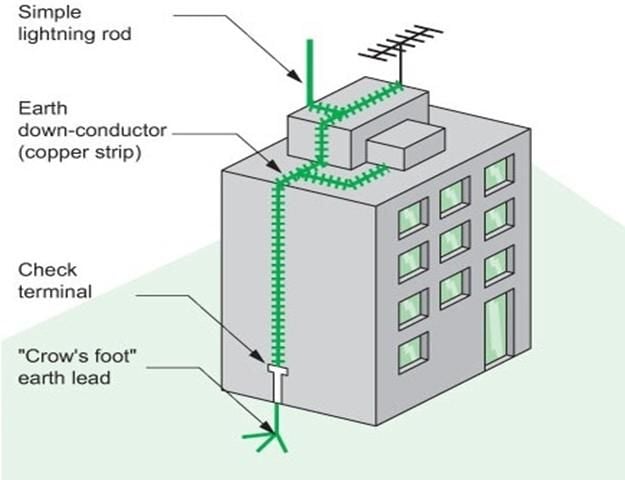
Conventional systems use the Franklin rod as their air terminal. This classic lightning rod was first used in 1753 by the scientist Benjamin Franklin. Originally, it was simply a long metal rod running from the top of a structure down to the ground. The conventional rod has a pointed tip to attract the lightning flash. Later, to improve safety, a porcelain sleeve was added to prevent lightning from affecting the structure.
A conventional system only comes into play during a thunderstorm. At that point the clouds carry a negative charge and the ground a positive charge, creating a very large potential difference between them, and lightning forms. Raised, pointed objects on the ground are where the electric field is strongest, so that is where lightning tends to strike (which is why, in a severe thunderstorm, you should not stand on high ground or shelter under a tree, but crouch low instead). This is where the pointed tip of the conventional rod does its job. Being tall and sharp, the rod concentrates a strong electric field, so the lightning strikes it, and the rod then carries the current down into the ground.
The protection zone of a conventional system depends on the height of the rod and is determined empirically.
The advantages of this system are its low cost and easy installation. However, it requires a complex network of conductors that spoils the look of the building, and both its level of safety and its protection zone are limited. If the system is made of steel, it has a short service life and costs a lot to repair and maintain.
Modern lightning protection systems
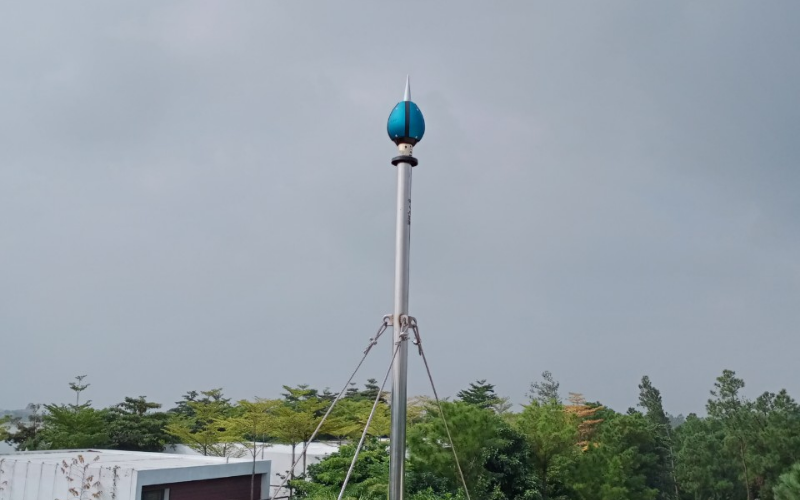
This type of system uses a modern air terminal based on the early streamer emission (ESE) principle. The rod incorporates an ESE head that strengthens the electric field at its tip, making it easier to emit an upward leader. This gives the terminal more time to capture the lightning current and extends the protection zone of the system.
The system also includes conduction and earthing (the earth termination), made up of down conductors and an earthing well with a standard depth of 20 metres and a diameter of 60 mm. If no well is drilled, copper-clad steel rods or chemical earth rods must be driven to a depth of 3 metres, although this is less effective than a well. The resistance must be re-measured every year, and more rods added if it no longer meets requirements.
Modern systems offer a high level of safety against direct strikes and let you choose the exact point on the building where lightning will strike. They are also simpler and faster to install than conventional systems, and their simple conductor layout keeps the building looking tidy. Fewer terminals are needed, and each one has a wide protection radius, so the overall protection zone is larger. Installed to standard, a modern system has a very long service life and saves on maintenance and repair costs.
Surge (induced lightning) protection systems

Usually installed where the line enters the substation to divert lightning surges to earth.
This type consists of 3 parts: the surge arrester, the conductor and the earthing system.
A surge protection and filtering device typically comprises:
- A primary surge arrester installed at the front (line side)
- A harmonic and noise filter ( in the middle)
- A secondary surge arrester installed at the rear (load side)
The primary and secondary arresters are made of metal oxide, usually zinc oxide. They conduct at high voltage and act as insulators at low voltage: the higher the voltage, the more current they pass, and as the voltage falls, so does the current. The harmonic and noise filter is built from an inductor (choke) and filter capacitors.
Installation method for a direct-strike lightning protection system
Installing the earthing system
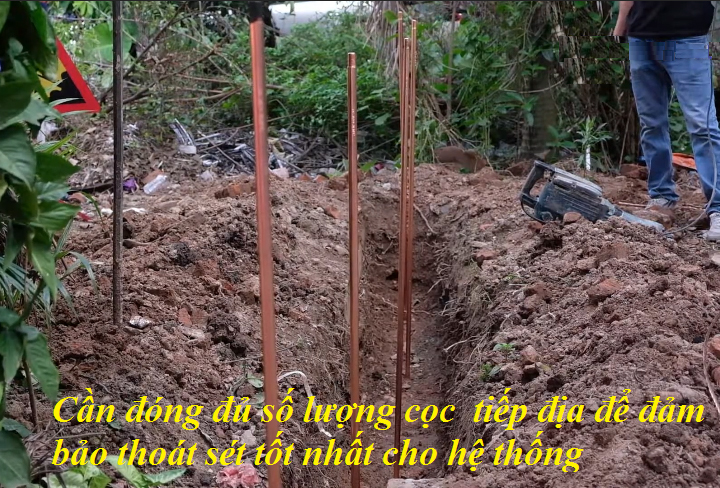
The first step in installing lightning protection is to dig the earthing trench, laid out to suit each site. The trench is typically 0.8m deep and 0.5m wide. Once it reaches the right depth, the earth rods are driven. We use special copper-plated earth rods 16mm in diameter and 2.4m long; the number of rods depends on the scale of each project. When driving the rods, keep them in a straight line, spaced at least one rod length apart. The rod heads are then connected with bare copper earthing cable with a 70mm cross-section, using exothermic welds that give excellent conductivity and a permanent, durable joint. (A drilled earthing well can also be used and is even safer.)
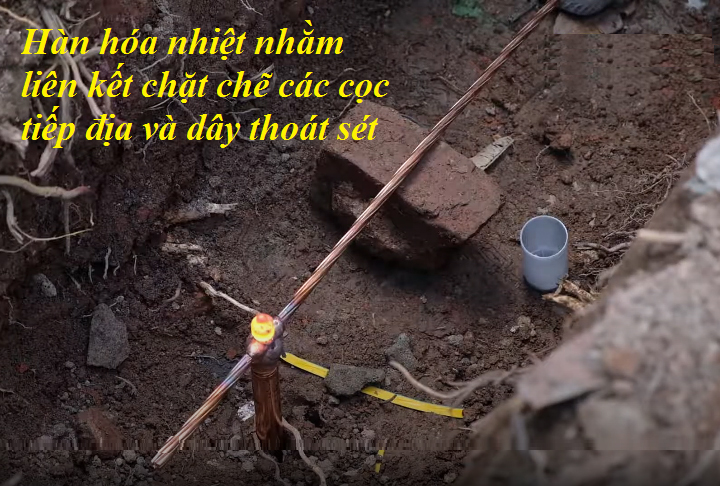
Exothermic welding
Exothermic welding bonds the earth rods together via the bare copper cable. Before welding, preheat the mould for about 2-3 minutes, then thoroughly clean the mould and the parts to be welded, such as wires, cables and rods…
Next, place the parts in the correct position in the mould and secure them with the clamp. Put the metal disc in the bottom of the mould and pour in the exothermic weld powder, following each manufacturer’s recommended charge for each type of joint. Pour the starting powder from the red cap at the bottom of each weld cartridge, sprinkling it over the weld powder and up to the edge of the mould
Then use the flint igniter to light the starting powder and trigger the exothermic reaction. When the weld is complete, let it cool for about 1 minute before opening the mould lid. Afterwards, remember to clean the joint between the bare copper cable and the earth rod. Always let the mould cool naturally and never dip it in water: the mould is still very hot, and sudden cooling will crack it.
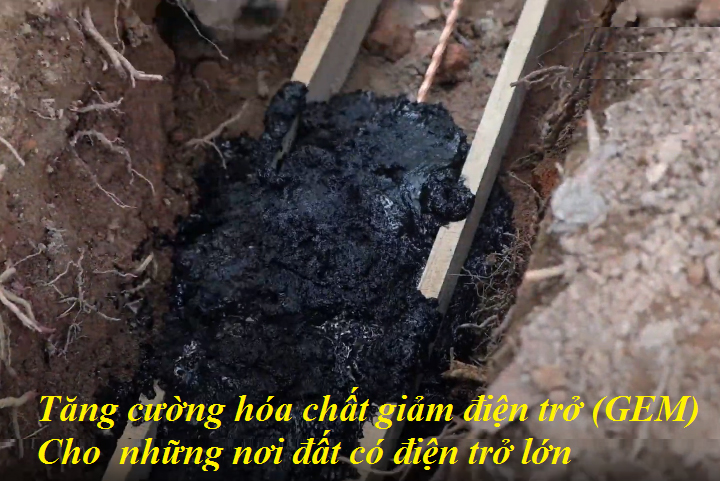
Adding ground enhancement material (GEM)
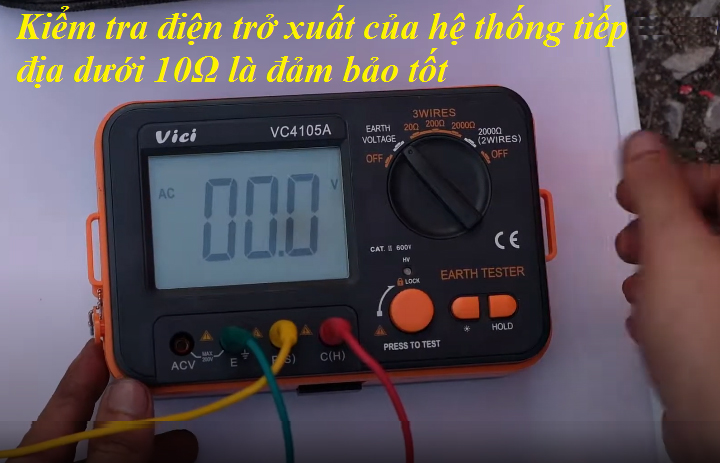
Once the earthing system is in place, the resistance-reducing compound is added. GEM (ground enhancement material) is poured along the earthing trench until it fully covers the earth conductor to the required thickness, and the trench is then backfilled. Some sites do not need GEM, but this must be decided on the basis of instrument readings: our engineers determine whether the soil in that area needs it. The compound helps discharge lightning faster, lowers the resistance of the earth electrode and keeps that resistance stable over time. The resistance of a lightning protection system must not exceed 10Ω
Testing the resistance of the earthing system
– If the earthing resistance is less than or equal to 10Ω, installation continues. If it is greater than 10Ω, we follow this procedure
+ Re-measure and recalculate the soil resistivity on site
+ Add more earth rods and resistance-reducing compound
+ Prepare method statement drawings for the next stage and submit them for approval
+ Carry out the work according to the approved drawings
– Once the earthing resistance meets requirements, we run the down conductors for the lightning protection system
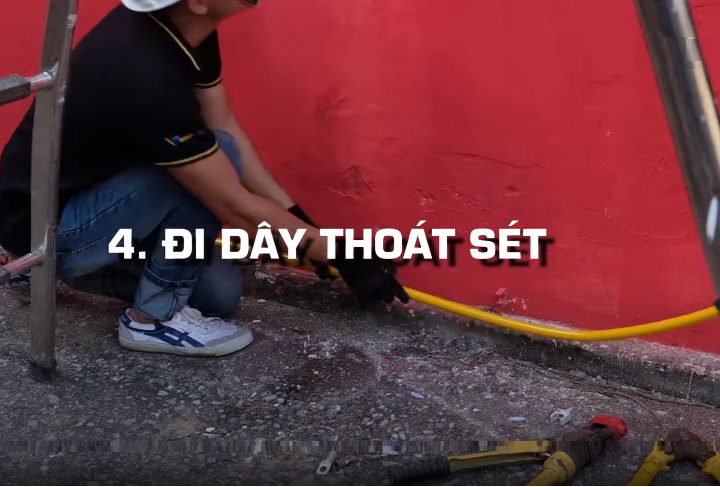
Running the down conductors
– The down conductor is an insulated copper cable run inside PVC conduit. It runs from the tip of the air terminal down through the mast, is fixed to the wall, passes through the lightning strike counter and then through the test box, which is mounted about 1.2m above ground level.
– When running the down conductor, never bend it at 90 degrees, as this reduces how quickly lightning current can be discharged
Erecting the air terminal mast
The air terminal is the part of the lightning protection system that makes contact with the lightning flash. It carries the lightning energy through the components of the system and down into the ground via the earthing system. The air terminal stops lightning from affecting the area it protects, so electrical equipment within the specified radius is unaffected and risks to life and property in the area are minimised
The air terminal is mounted on a stainless steel mast about 5m high, firmly fixed to the roof with a base assembly. With this system in place, there is no need to worry during storms and thunder. Note that the lightning protection system should be inspected every year to keep it performing at its best

If you need design and installation advice for a LIGHTNING PROTECTION system, please contact TechConnect Vietnam for expert advice and support.
TechConnect Vietnam Engineering and Trading Co., Ltd
- Address: FLC Garden City Urban Area, Dai Mo Ward, Nam Tu Liem District, Hanoi
- Hotlines: 0988 883 961/ 0987 989 822
- Email: techconnect.mepf@gmail.com
- Website: https://techconnectmepf.com/en/